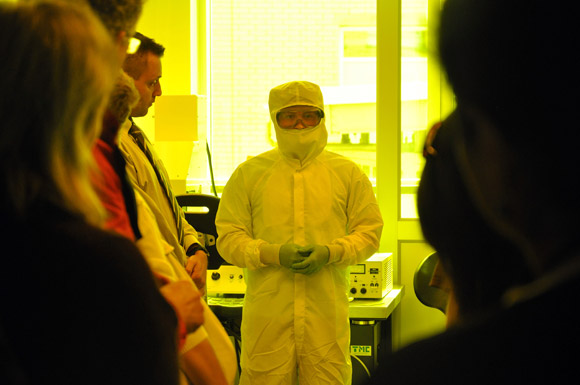
An engineering student tours guests through the class 100 clean room in the new Micro Electro Mechanical (MEMS) Fabrication facilities.
New engineering labs and equipment support research and industry collaborations
When you need to create a device that’s 1/100th the width of a human hair, you don’t wander into the garage and grab your drill.
You head to the new Micro Electro Mechanical System (MEMS) Fabrication facilities at UBC’s Okanagan campus, put on a clean room “bunny” suit, enter a class 100 clean room that provides a dust-free atmosphere, and use a combination of chemistry, light technology and lasers to fabricate devices — or microsystems — as small as one-millionth of a metre, also known as a micron (μm).
What the design and application of that microsystem might be is as varied as the expertise of the UBC researchers who are creating it.
“The tools we have access to in the MEMS lab are incredible,” says Jonathan Holzman, associate professor in the School of Engineering at UBC’s Okanagan campus. “But I would say that the greatest advantage is not so much the equipment, but the people who use it. We have a diverse and talented faculty in mechanical, civil and electrical engineering working together creating solutions for a wide scope of industry and community partners, both locally and globally.”
This multidisciplinary approach often leads to an interesting subset of applications and ways to approach different problems, Holzman adds.
For example, Holzman, who is an electrical engineer specializing in micro-sensor technologies, is collaborating with UBC mechanical engineering colleagues specializing in micro-fluidics to improve water quality sensing for the City of Kelowna.
“We are developing a very small microsystem — essentially a lab on a chip — with multiple sensing techniques that has the ability to quickly detect cryptosporidium pathogens in water, helping to ensure a potential problem in water quality can be detected before it makes its way into the public water systems.”
It is essential for the MEMS lab to be able to test and view the microsystems in tremendous detail. That’s where the Scanning Electron Microscope (SEM) facility comes in — another new lab completed this year at UBC’s Okanagan campus.
Andre Phillion, assistant professor of mechanical engineering, explains the SEM is a microscope that uses electrons instead of light to produce a detailed high-resolution image with considerable depth of field. The SEM, with a price tag of about $500,000, has applications for a variety of disciplines, including forensics, agriculture, forestry, mineral exploration, biofuel development, manufacturing and much more.
“An SEM is one of the most versatile instruments for the study of solid materials — you can resolve features in an object that are as small as four nanometers,” says Phillion. “It is an essential research tool that enables students and faculty from multiple disciplines to examine a sample and then understand the composition, texture and functionality of the object they are working with.”
The Charles Fipke Foundation donated $500,000 to cover the cost of the SEM, located in the Fipke Centre for Innovative Research, and Western Economic Diversification (WED) Canada contributed $1.35 million to support its operational requirements, as well as build the MEMS fabrication facilities.
Holzman notes that with new technologies and the rising demand for everyday devices to do more using less space and energy, microsystems — often grown in a lab atom by atom — play an increasingly important role in our everyday lives. They are part of the reason why our cell phones can sense the slightest shift in direction, and cars have the ability to tell when our tire pressure is low, or deploy an airbag upon impact.
“The really cool thing about the SEM and MEMS labs is that they not only serve and benefit the campus, but are really a great resource for industry and our community as well,” says Holzman. “Much of the work going on within these labs has resulted from partnerships with Western Canadian business and industries who want to create more efficient and effective solutions for the people living, working and doing business in our communities, province and country.”
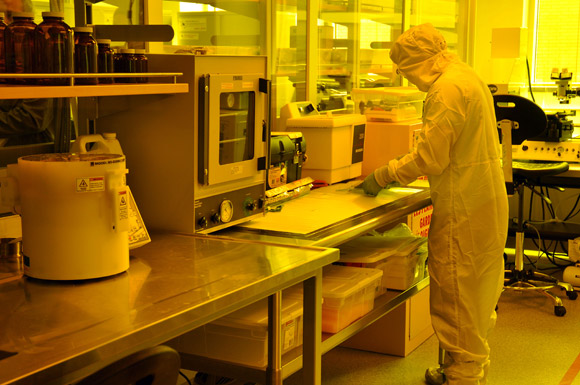
An engineering student works in the class 100 clean room in the new Micro Electro Mechanical (MEMS) Fabrication facilities at UBC's Okanagan campus.
— 30 —