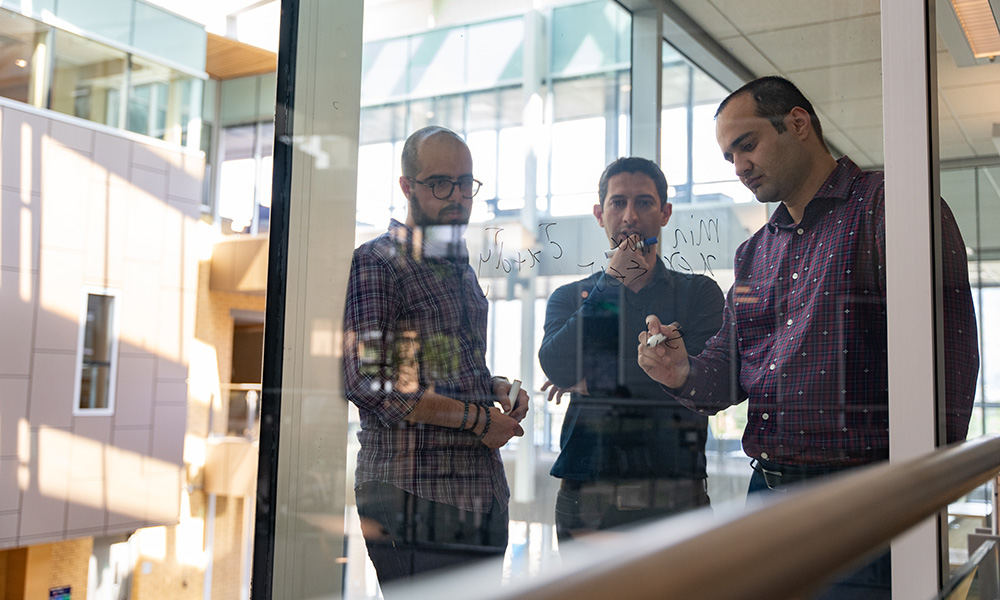
Faculty of Management researchers Dr. Amir Ardestani-Jaafari (right) and Dr. Amin Ahmadi Digehsara discuss their gaming strategy that helps protect infrastructure from attack with student Mohammad Mosaffa (left).
As technology continues to advance, the likelihood of malevolent attacks and subsequent failures on society’s critical infrastructures increases. Blackouts, water shortages, transport collapses—these potential threats to cities not only come with a hefty price tag but are likely to cause chaos and affect the health and safety of communities.
UBC Okanagan Postdoctoral Research Fellow Dr. Amin Ahmadi Digehsara, along with Assistant Professor Dr. Amir Ardestani-Jaafari, both with the Faculty of Management, recently published a study that will enhance the resilience of vital infrastructures against malevolent attacks.
“We rely heavily on various interconnected systems and networks, like electricity, water and transportation,” says Dr. Ahmadi Digehsara. “Imagine these networks as a series of roads and intersections. If certain roads or intersections are blocked due to an attack or disaster, it can cause significant problems within our community.”
Their study tackles the ever-growing challenges associated with safeguarding power stations, water systems, railways, highways, subway stations, roads and other key components of a community’s infrastructure. As threats, ranging from warfare and criminal acts to terrorism, continue to loom it becomes imperative to devise robust strategies to defend against these vulnerabilities.
“Our research is crucial because it helps us better prepare to support our communities during disasters,” says Dr. Ahmadi Digehsara. “By identifying which roads and intersections are crucial, we can reinforce them so our daily lives are less disrupted during emergencies. This isn’t just about avoiding inconvenience; it’s about ensuring safety, health and even saving lives during disasters.”
Dr. Ardestani-Jaafari explains how they used a gaming strategy to devise ways to prevent potential blockages or infrastructure attacks.
“For our research, we acted like city planners. By thinking ahead, we try to strengthen important roads and intersections—we call these nodes and links—to keep the city running smoothly, even when trouble happens,” he says. “However, it’s tricky because we don’t know exactly where or how these blockages might occur. So, we’ve created a three-part strategy, like a game, involving a defender which is us, an attacker who created blockages, and then the defender again.”
In their study, the first defender makes strengthening plans and the attacker finds weak spots to hit and create damage. Then the second defender makes quick moves to fix issues and find the best paths within the damaged network.
“To figure out how to do this efficiently, we used a special method—like a problem-solving tool—to test our strategy on known examples. We found out that with smart planning, we can make really strong protection plans quickly, even when facing complex problems.”
The research, published this month in Annals of Operations Research, proved that by strengthening the most important roads and intersections, cities become more resistant to unexpected disasters and attacks. Their paper also determined that by properly preparing for disaster, the financial consequences can be decreased.
“Even if we don’t know exactly what’s coming, we have smart tools and strategies that help us prepare to respond effectively,” adds Dr. Ardestani-Jaafari “Our approach isn’t just theoretical. We’ve tested it, and it will keep things running more smoothly in emergencies while simultaneously saving money and resources in the long term.”
Though the research is promising, Dr. Ahmadi Digehsara cautions that as threats change and networks continue to grow, it is imperative to keep adapting to these changes in order to improve defences.
“This isn’t a one-time effort,” he says. “As threats change and our networks grow, it is important to keep adapting and improving the response. In simple terms, we’re like the guardians of the city’s lifelines, working behind the scenes to make sure everyone can continue living their lives with minimal disruption, no matter what surprises come our way.”