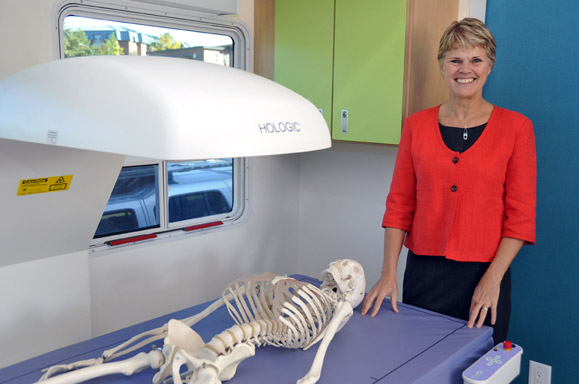
Heather McKay, Director of the Centre for Hip Health and Mobility, with one of the medical imaging systems housed in the new mobile lab that will be used for bone and hip health research throughout B.C.
The Centre for Hip Health and Mobility (CHHM) at Vancouver General Hospital introduced its new mobile research lab — the first of its kind in Canada — at UBC Okanagan on Wednesday morning, as the Centre launched the lab’s inaugural bone health and mobility pilot study.
Dedicated to better understanding mobility and bone health across the lifespan, the mobile lab is able to travel to communities throughout the province, assessing seniors, children, and adolescences to collect information on mobility and bone health. Professor Heather McKay, Director for the CHHM, and Dr. Allan Jones, Regional Associate Dean, Faculty of Medicine, UBC Okanagan, announced the first pilot study, which will be conducted in Vernon and Kelowna.
In Canada, two hip conditions — arthritis and fracture — account for over $16 billion in annual health care costs. In 2007/2008 fall-related injuries in B.C. cost health authorities over $155 million dollars. Falls among seniors result in over 4,000 hip fractures annually, with an average annual hospital cost of $75 million.
“Bones and joint diseases not only impact the health care system, they also have devastating effects on the quality of life for those affected,” says Dr. Maureen Ashe, Assistant Professor at UBC and member of the Centre for Hip Health and Mobility, who will be conducting the study. “One of our research participants who recently suffered a debilitating fall said to us ‘the moment I hit the floor – I knew that my life had changed forever’ and this is precisely the case.”
The mobile lab houses state-of-the art equipment for medical imaging of bone, and falls risk screening tools for population-based research. The equipment in the lab is capable of evaluating bone mass and strength in 3-D, measuring total body bone, fat, and muscle mass and predicting the future risk of falls with 75 per cent accuracy.
In the first study conducted by the mobile lab, researchers aim to characterize recovery in seniors following a hip fracture. Participants’ mobility, falls risk, bone health, physical activity patterns and other key health determinants of fracture risk will be assessed. Measurements conducted in the mobile lab and information gained from this pilot study will inform patient care pathways as well as future research projects on hip fracture recovery.
“The Centre for Hip Health and Mobility’s mobile lab takes us one step closer to achieving our goals to prevent the devastating consequences of falls and fall related fracture; to detect arthritis earlier than has previously been possible and finally to treat these conditions and their consequences with novel interventions and surgical techniques so as to preserve, restore and enhance mobility – across the lifespan,” says Dr. McKay.
“This lab is another example of how the University of British Columbia’s Faculty of Medicine has become a province-wide enterprise,” says Dr. Jones. “Just as we expand our educational programs throughout British Columbia, our researchers are also reaching farther afield to get the most comprehensive, diverse data about the health of the population of the province. The insights from that information will ultimately inform our teaching of future health professionals, and our continuing education programs for experienced physicians and therapists.”
Researchers will now have the capacity to assess populations living in urban, rural, and remote regions and to access frail populations in Vancouver and its regions who have until now been inaccessible due to lack of equipment in these areas. Data gathered will identify B.C.-specific trends in bone health and provide insight about enhancing mobility across the lifespan.
“Our region is comprised not only of an aging population, but also a rural one, and this mobile lab will assist in gathering data to further support the work and research on patient safety and falls prevention that is already underway in Interior Health,” says Tom Fulton, Chief, Professional Practice, Nursing and Quality Improvement, for the Interior Health Authority.
About the Centre for Hip Health and Mobility
Established in 2004, the Centre for Hip Health and Mobility (CHHM) is based at Vancouver General Hospital. The Centre is a partnership between the University of British Columbia’s Faculty of Medicine and Vancouver Coastal Health (VCH) through the VCH Research Institute. CHHM is unique in its commitment to enhance mobility through bone and joint health as a means to enhance the quality of life for all Canadians. One key focus of this internationally recognized research and teaching centre is the cluster of clinicians and scientists with particular expertise in hip health.
— 30 —