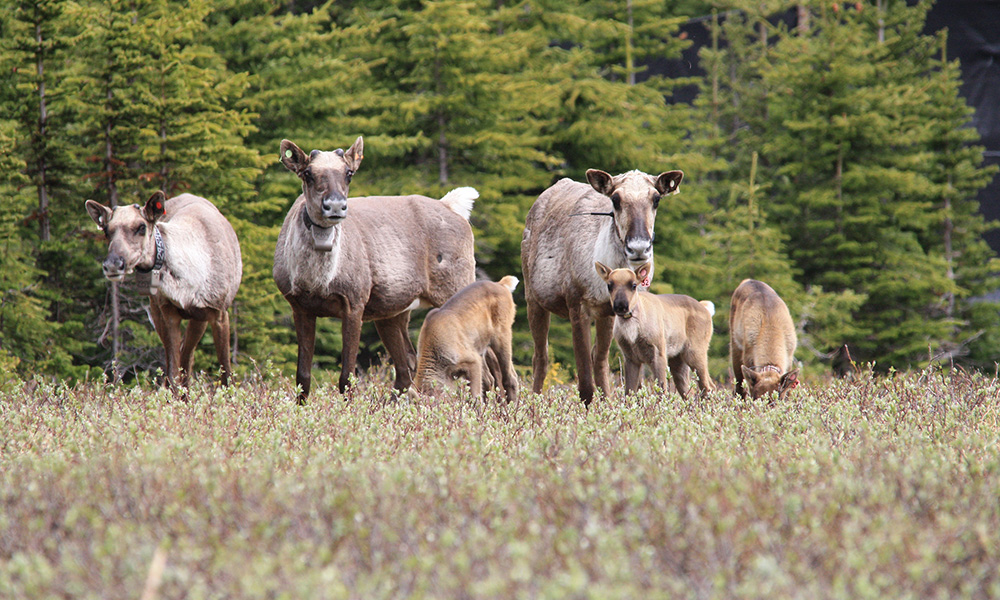
New research from UBC Okanagan’s Dr. Clayton Lamb examines how to preserve southern mountain caribou populations until the animal’s habitat can sustain greater numbers. Photo credit: Line Giguere/Wildlife Infometrics.
Thanks to drastic and evidence-based solutions, more southern mountain caribou roam Western Canada today than in previous decades; however, herd numbers are too fragile to sustain themselves without continued intervention.
That begins the conclusion of a new research paper published in Ecological Applications on Thursday by a team of wildlife and biodiversity researchers led by Dr. Clayton Lamb, a postdoctoral fellow at UBC Okanagan and Wildlife Scientist at Biodiversity Pathways.
“We did this analysis with full understanding and agreement that habitat loss is the primary driver of caribou declines,” says Dr. Lamb. “But the reality is that habitat restoration, even once complete, will take decades to produce the mature forests and low predator densities caribou need to survive. In the meantime, we need evidence-based actions to sustain caribou while we expedite habitat conservation and restoration.”
Researchers found that while caribou have declined dramatically over the past few decades, there are 52 per cent (or less than 1,500) more caribou on the landscape than if no recovery actions had been taken.
Southern mountain caribou are among the most threatened large mammals in Canada. The ultimate reason for caribou decline is human-caused habitat loss and increased predation. It’s thought that it will take decades to restore enough habitat for populations to recover, and the outcomes of restoration are still unknown.
Across BC and Alberta, managers have tried maternal penning, supplemental feeding, translocation and reducing predator density to help stabilize caribou populations.
“Caribou declines have been drastic, and the actions required to keep them from completely disappearing have had to be bold, and many have been understandably contentious,” says Dr. Lamb. “Our task was to assess whether and how these recovery actions have helped southern mountain caribou in their struggle to survive.”
Researchers from across BC and Alberta pooled and analyzed over 50 years of data on the species, using population estimates from aerial surveys and information on caribou mortality from collared animals.
Though the earliest data comes from 1973, data collection began for most populations after 1991. The team found that the southern mountain caribou abundance declined by 51 per cent between 1991 and 2023. Still, without recovery actions, the decline would have been even more significant.
“We have 1,500 more caribou than we would have had without these actions,” says co-author Dr. Rob Serrouya, Co-Director of the Wildlife Science Centre with Biodiversity Pathways. “There is strong evidence that predator reductions have increased caribou populations and avoided further caribou extirpation events. We’ve seen this increase under current levels of climate change; high levels of habitat loss also contribute.
“Actions such as maternal penning and supplemental feeding were most effective when coupled with predator reduction. Other actions, such as prey reduction, wolf sterilization or translocations, had a lesser impact.”
Researchers from both UBCO and Biodiversity Pathways analyze and report on the status of caribou populations, offering clear data to inform the conversation on conservation efforts and support the best outcomes for ecosystem health.